Can introverts be strong leaders?
By TestMyTraits team··8 min read
If you lean toward the I in your four letters, you've probably heard that leaders are outgoing. Loud voices get noticed in meetings, and the person who talks first often ends up in charge. That part is true. The research also shows it's a bad guide to who leads well.
This piece goes through what studies of real teams have found: who gets picked, who does well, which part of extraversion matters, and what it costs an introvert to lead in a way that looks outgoing. Each figure links to its source at the bottom.
Who gets picked and who does well
A large review in 2002 pooled 73 samples on personality and leadership. Extraversion had the strongest link of the five big traits, at .31. On this scale 0 means no link and 1 means a perfect one, so .31 is real but modest. Conscientiousness was close behind at .28.
The split is what matters for introverts. Extraversion predicted who got chosen as leader (.33) more than who was rated as leading well (.24). Groups reach for the person who speaks up. That doesn't mean the person who speaks up does the job better.
When quiet leaders come out ahead
In 2011, researchers tracked 57 stores of a US pizza delivery chain for seven weeks. When employees were passive, stores with extraverted managers earned more. When employees were proactive and brought their own ideas, stores with introverted managers earned more.
A lab version with 56 groups folding T-shirts came out the same way. The explanation the authors gave: extraverted leaders were less open to ideas from below. Introverted leaders listened, and proactive teams did better for it. So the better style depends on the team. A team that waits for direction may need a louder lead. A team full of ideas needs someone who'll hear them.
Why the loudest voice can fade
A 2013 study followed MBA study teams over about ten weeks. Extraverts started with high status in their groups. Over time their standing dropped, because what they delivered didn't match the impression they first made.
A separate study of 607 people in 161 teams looked at humble leadership: leaders who admit mistakes and point out what others do well. Their teams picked up the same habits, and those teams performed better. Humility isn't the same thing as introversion. But it shows a low-key style can lead well, and it's a style many introverts find easier than working a room.
- 10 weeksfor extraverts' early status to slipIn MBA teams, extraverts started high and lost standing when their work fell short of the first impression.Source 3
- 161teams copied their humble leadersLeaders who owned their mistakes and credited others built teams that did the same, and performed better.Source 4
Drive matters more than small talk
Extraversion is two things bundled together. One side is drive: being assertive, pushing toward a goal, taking charge. The other is being sociable: enjoying company and chat. A 2014 review pulled them apart. Drive predicted leadership. Being sociable didn't predict good leadership, and it went with lower effectiveness.
That matters if you lean introverted. You don't need to enjoy the office party to lead. You do need to state the goal, make the call and push for it. For some introverts that part comes easily. For others it takes practice, and the research suggests it's the practice worth doing.
- 2 sidesof extraversion, split apartAssertive drive predicted leadership. Being sociable didn't, and was linked to lower effectiveness.Source 5
Acting outgoing works, then sends a bill
In lab conversations of 10 to 20 minutes, people told to act outgoing felt better than when told to act reserved. Introverts felt the lift too. So leading in a visible way isn't doomed to feel bad.
There's a delayed cost, though. A study that checked in with 48 people over 12 days found outgoing behaviour went with better mood at the time and more tiredness about three hours later. That held for introverts and extraverts alike. The practical lesson is to plan for it. A day of back-to-back meetings needs gaps, and a big presentation needs a quiet hour after it. For a one-tap look at your own comfort zone, pick a seat in a room full of people.
What it costs to lead as an introvert
Introverts are under-represented at the top. By the test publisher's own figures, about 57% of people prefer introversion but only 39% of US senior leaders do. It published no sample size, so treat the gap as rough.
Part of that gap is about being noticed. If groups pick the person who speaks first, a quiet person can be passed over before anyone sees their work. Some costs come from your own habits. Teams can read your silence as disapproval when you're only thinking. You may hold back an idea until it's perfect, and by then the decision is made. And if you never say what you've done, someone else's version of events tends to win.
None of these is fixed. Saying out loud that you're thinking it over, sharing a rough idea early, and keeping a short note of what your team delivered all cover the gaps without asking you to become someone else.
- 39%of US senior leaders prefer introversionCompared with about 57% of people overall, by the test publisher's own data. No sample size was given.Source 8
What to do at work if you lean introverted
You don't need a new personality to lead well. You need a few habits that play to how you already work and cover the spots where quiet gets misread. Each one below comes from the studies above. Pick two to try this week rather than all seven at once.
Ask for ideas, then use one
Listening is where introverted leaders came out ahead. Ask your team one direct question in each meeting, and when an idea is good, act on it and say whose it was.
Backed by source 2Say the goal, then make the call
Drive is the part of extraversion tied to leading well, not small talk. Open with the goal in one sentence. Close with a decision, an owner and a date.
Backed by source 5Share the rough version in the room
Groups tend to follow whoever speaks first. Give your half-formed view in the meeting, then send the polished one after, before the decision sets.
Backed by source 1Say why you've gone quiet
Silence gets read as disapproval. One line fixes it: "I want to think this through. I'll reply by 3pm." Then reply by 3pm.
Own your mistakes out loud
Teams copied leaders who admitted errors and named what others did well, and those teams performed better. Start with a small one at the next check-in.
Backed by source 4Make your team's work visible
Standing in groups shifts toward people whose work holds up, but only if people see it. Send a short weekly note: what shipped, who did it, what's next.
Backed by source 3Leave gaps in your calendar
Outgoing stretches feel fine at the time and tiring a few hours later. Keep 15 minutes free after big meetings, and don't stack a presentation right before a hard one-on-one.
Backed by source 7
Your I is a lean, not a box
Extraversion is a sliding scale. Studies of type scores going back to the 1960s find most people near the middle, not in two clear camps. On retest, the E/I letter is the steadier one, with a consistency of about .76, but people close to the middle still flip.
So ask how strongly you lean, and which leadership habits come easily from where you sit. Someone with a slight I lean may find visible leading cheap. Someone with a strong one may need to plan their recovery time more carefully. That's why this site shows the strength of each lean, not only the letter.
- .76retest consistency of the E/I letterAmong the steadier letters, but people near the middle of the scale can still get the other letter next time.Source 9
Common questions
Can introverts be good leaders?
Yes. Extraversion predicts who gets picked as leader more than who leads well. In a study of 57 pizza stores, introverted managers' stores earned more when staff were proactive. A quiet, listening style works especially well with teams that bring their own ideas.
Are extraverts better leaders?
Only slightly, on average, and it depends on the team. The link between extraversion and leadership is modest. The useful part is drive and assertiveness. Being sociable wasn't linked to better leadership, and extraverted leaders did worse than introverted ones with proactive teams.
Should introverted leaders act more outgoing?
It can help in the moment. People feel better acting outgoing for short spells, introverts included. But tiredness tends to follow a few hours later, so plan breaks after heavy meetings rather than trying to keep it up all day.
What percentage of leaders are introverts?
By the Myers-Briggs Company's own figures, about 39% of US senior leaders prefer introversion, against about 57% of people overall. The company didn't publish its sample size, so the numbers are a rough guide.
Sources
- Judge, Bono, Ilies & Gerhardt (2002). Personality and leadership: a qualitative and quantitative review. Journal of Applied Psychology
- Grant, Gino & Hofmann (2011). Reversing the extraverted leadership advantage: the role of employee proactivity. Academy of Management Journal
- Bendersky & Shah (2013). The downfall of extraverts and rise of neurotics. Academy of Management Journal
- Owens & Hekman (2016). How does leader humility influence team performance? Academy of Management Journal
- Do & Minbashian (2014). A meta-analytic examination of the effects of the agentic and affiliative aspects of extraversion on leadership outcomes. The Leadership Quarterly
- Fleeson, Malanos & Achille (2002). An intraindividual process approach to the relationship between extraversion and positive affect. Journal of Personality and Social Psychology
- Leikas & Ilmarinen (2017). Happy now, tired later? Extraverted and conscientious behavior are related to immediate mood gains, but to later fatigue. Journal of Personality
- The Myers-Briggs Company (2020). Setting the record straight on World Introvert Day
- Randall, Isaacson & Ciro (2017). Validity and reliability of the Myers-Briggs Personality Type Indicator: a systematic review and meta-analysis. Journal of Best Practices in Health Professions Diversity
- Stricker & Ross (1962). An assessment of some structural properties of the Jungian personality typology. ETS Research Bulletin
Tests that fit this
Picked for this topic. The quick ones take a few seconds; the full test measures all four scales.
Free personality test
Shows how strongly you lean toward introversion, not just the letter, which is what decides how much visible leading costs you.
Start →
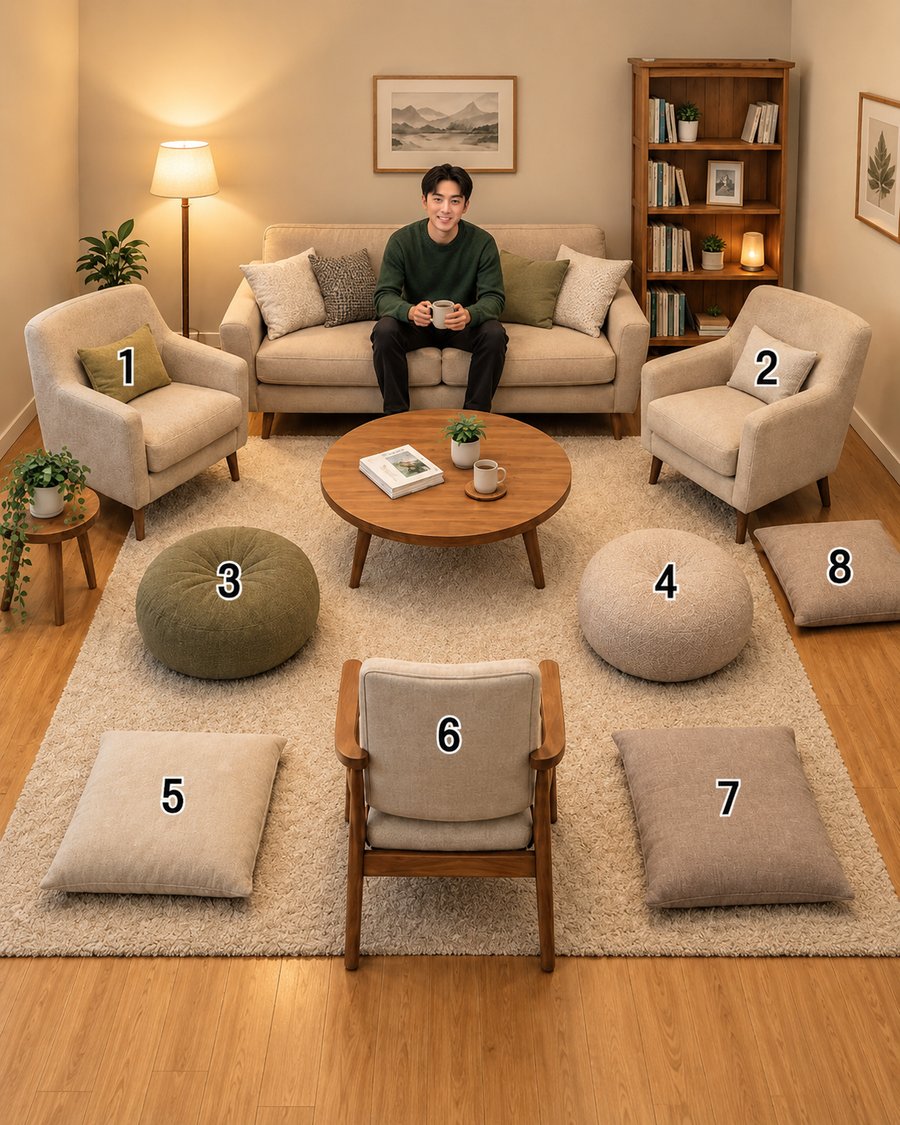
Where would you sit?
A one-tap look at where you'd sit in a room full of people: in the middle of things or at the edge.
1 question · 8 choices →