Room test: which seat would you take?
By TestMyTraits team··1 min read
Picture walking into this room — which numbered seat would you take?
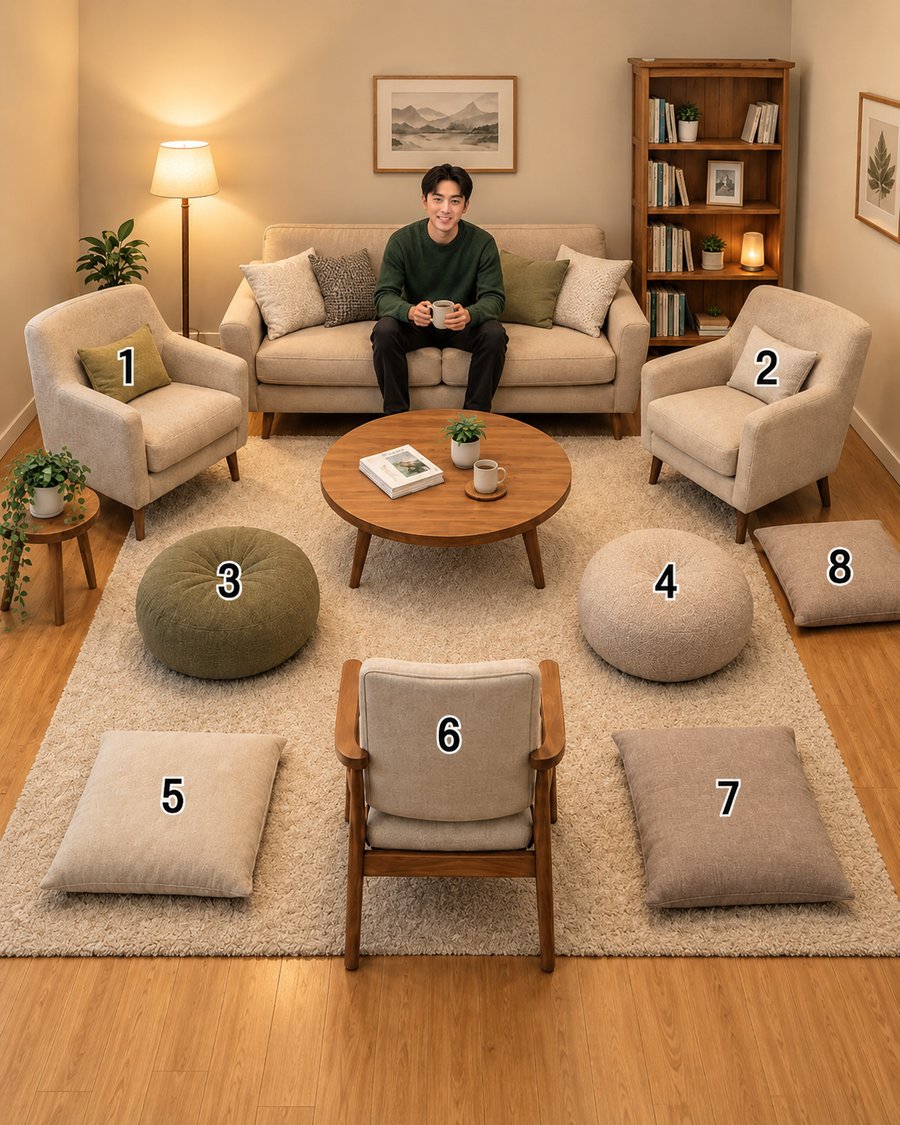
Pick one to see the reading.
Show all 8 readings — spoils the quiz
1.Left armchair — Warm underneath, guarded on the surface
Company genuinely appeals, and solitude doesn't feel like a hole — the two aren't opposites for you, they're just different settings. You adjust how close you let someone get case by case, and it's uncomfortable when someone assumes closeness earns them access to everything. The cost: from the outside this can read as detached, and the people who never get past that read miss the warmth the ones closer to you already know is there.
2.Right armchair — You read the room before anyone speaks
You're tracking tone and expression at least as closely as the words themselves, and a flat "I'm fine" rarely goes unquestioned in your head. Trust builds slowly, but once it's there you remember details most people would have let go. The cost runs one direction: you notice everyone else's shifts in mood long before anyone thinks to check on yours.
3.Green pouf — Your own way, adjusted as you go
You do things your way because they fit, not to make a point, and you'd rather find out what actually works for you than take someone else's word for it. Plans changing doesn't rattle you — you just route around it. What it costs: advice bounces off more than it should, even the useful kind, because the instinct to decide for yourself doesn't pause to sort good input from noise.
4.Tan pouf — Close by, and still fully at rest
Being near people and having room to switch off aren't in tension for you — shared silence with someone else in the room reads as closeness, not distance. You don't need constant activity or conversation to feel connected. The cost is that this can look like disengagement to someone who reads closeness as needing to always be doing something together.
5.Left cushion — People exhale around you
People tend to say more around you than they planned to, mostly because you actually let them finish before responding. It doesn't take much talking on your part for someone to feel steadier after. The real cost: you're worth checking on too, and the role of the one who listens can quietly run you down if nobody — including you — remembers that.
6.Wooden chair — Prepared before anyone asks
You're the one who already checked what time it starts, whether anyone forgot something, and who looks like they're having a rough night — usually before anyone asks. Care shows up as logistics more than words for you. The trade-off: this reads as low-key, thankless work unless someone actually notices the gap it fills, and it usually goes unnoticed right up until it's missing.
7.Right cushion — Slow to open, hard to lose
New people get politeness, not access — those are different things to you, and being friendly isn't the same as being open. It takes real, accumulated proof before the guarded version of you steps back. Once someone's in, though, you don't go quiet on them when things get hard. The cost is that people who only ever get the first version sometimes never find out there's a second one.
8.Corner cushion — Alone first, steady after
Your own space isn't a preference, it's closer to a requirement, and you'd rather watch a situation for a while before deciding how much of it is yours to get involved in. Untangling a hard week happens alone, in your own head, not out loud with someone else's input in the middle of it. The cost: this can read as shutting people out exactly when they're trying to help, even though for you it's just how you actually get steady again.
How seriously to take this
Not very — and that's the honest answer. A single question can point at a lean, but it can't measure one: there's nothing to average, so there's no way to separate a real tendency from a coin flip. It's a conversation starter that happens to be built on the same four scales as the full test, rather than on nothing at all.